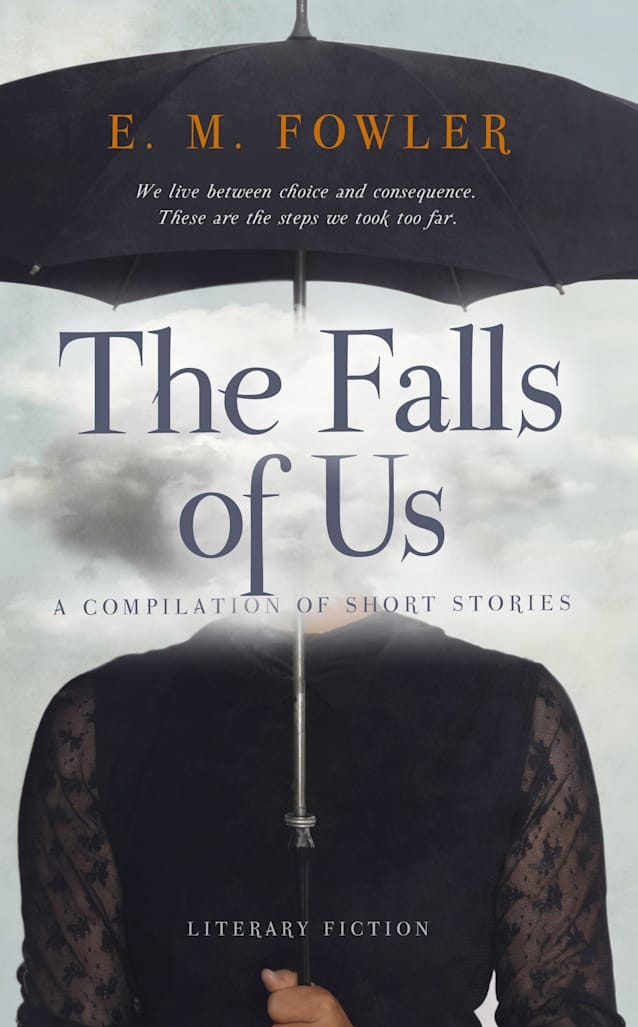
The Falls of Us
About
In these sharp, genre-bending short stories, ordinary lives crack under the pressure of systems that were never built to sustain them. A grandmother in “Fragments” fights to hold on to herself as dementia splinters her memories, while those who love her watch the person they know slip away in pieces. In “Memory Stoned,” a policy analyst is offered a chance to feel other people’s memories, raising the question of whether borrowed empathy makes us more compassionate or just better consumers, and whether she’s regulating her feelings or quietly becoming addicted.
“Expiate” follows two strangers pulled into a ritual of public repentance where even small acts, like being asked to remove your shoes, become measures of guilt and worthiness. In “Cliffhangers,” a driving lesson gone wrong leaves an instructor and her student stranded on a literal ledge, forcing them to confront entitlement, generational survival, and the thin line between accident and consequence.
Blending literary prose with speculative twists, The Falls of Us is a collection of microfiction, flash, and full-length short stories for readers of literary, speculative, and socially conscious fiction.
Praise for this book
Fowler is especially good at turning physical objects and ordinary situations into extensions of a character’s inner life. “Water Damage” makes a worsening leak and repeated coats of paint part of a woman’s determination to cover over the collapse of her marriage. “The Blue Curtains” uses a dimmed home and an unreliable narrator to gradually reveal how a mother is shaping her daughter’s view of her father. In “Fragments,” memory itself becomes unstable as the story enters the confusion of dementia, while “The Quiet Never Comes” captures workplace exhaustion through a woman who longs so badly for silence that even escape starts to feel unreachable. The collection’s strongest moments often come when Fowler lets a concrete image do the emotional work. A stain, a ledge, a prayer closet, a pair of curtains, or a disabled car can carry far more weight than its literal purpose suggests.
I really enjoyed the flow of this book. It has the kind of writing that makes you forget you are reading. I could just stay with it and let the story move along without feeling like I was working through the pages. The pacing felt natural, and I liked how the details came together without everything being explained too much. It pulled me in quietly and kept me there. By the time I finished, it felt less like I had read a book and more like I had spent some time inside its world.